by Ruby Cayenne
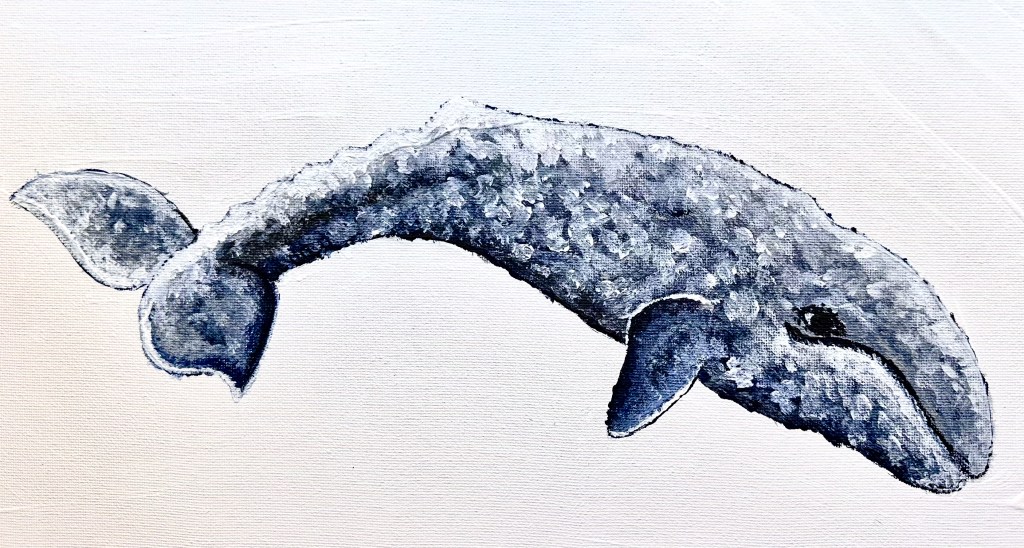
painting of grey whale by Ruby Cayenne
Humans press on as the Earth shies away from the clement climate that once was and shifts toward a scorching temporal reality. They do so with the abettance of many things that humankind has designed to lessen the deleterious nature of a warming planet. Animals, on the other hand, are forced to adapt to such calamities with nothing but that which they possess innately.
Natural selection may no longer apply to many humans by virtue of technological and medical advancements but wild animals unequivocally live under the pressing thumb that is survival of the fittest. Humans can, however, attain an improved comprehension of animals and their environments to inform what can be done to their advantage, if only the time is taken and the effort is made.
In Northern California, where the tides of the sweeping Pacific Ocean nearly touch expansive groves of redwood trees, the waters are consistently graced by the presence of gray whales (Eschrichtius robustus) divided into the Pacific Coast Feeding Group (PCFG) and the Eastern North Pacific Group (ENPG). The high population density of these groups is an indication of gray whales’ resilience. Their populations significantly rebounded once commercial whaling in the Eastern North Pacific concluded.
The majority of gray whales who live on the Eastern side of the Pacific Ocean basin make one of the longest yearly migrations of any mammal, approximately 12,000 miles, from the amiable waters of Baja, California in the winter to the biting waters of the Arctic in the summer. The PCFG,
however, never migrate higher than British Columbia and Humboldt County is at the southernmost edge of their Northern range. Gray whales can reach 40-50 feet in length and weigh more than 72,000 pounds when fully grown.
Dawn Goley, a professor of zoology at Cal Poly Humboldt and director of the Marine Mammal Education and Research Program (MMERP,) has been studying gray whales in Humboldt County since 1997. Recently, she and her graduate student Robyn Norman, who she co-advises with Paul Bourdeau, professor of marine biology and ecology as well as a graduate coordinator, have been researching the diet, abundance and distribution of the PCFG in Humboldt and Del Norte County. The PCFG has much smaller numbers, at approximately 230 individuals than that of the EN PG’s population which is estimated at 15,000.
“We know what is special about the North Coast, but what do gray whales think is special about the North Coast?” Goley said.
Norman, her team of advisors and a group of undergraduate student volunteers have found that locally consumed food is very distinct from that of other places throughout the PCFG’s Northern range and want to understand why the whales are not continuing their migration up into the Arctic. The group conduct ed studies on what food sources are available, what species the PCFGs are feeding on and what the prey’s energetics are. They collected sam ples from the water column, epiben thic zone, which refers to just above the sea floor and benthic zone, which means within the sediment.
“We’re going out every month across Northern California from Trinidad and Eureka up to like
Crescent City and Point St. George,” Norman said, when speaking about their sampling locations.
Gray whales eat invertebrates that float in the water column, called planktonic invertebrates, meaning they float and drift along at the will of ocean currents. They also feed on invertebrates that habitate in the epibenthic and benthic zones. In the Humboldt County area, gray whales have been found to mostly feed on benthic prey.
“So, they go down and take a big mouthful of mud, squish it around, and push all the water out through their baleen, which sieves all of the invertebrates, and so it captures the prey, but it pushes out the mud and the water, and then they slurp that down and do it again,” Goley said.
Gray whales are the only species of baleen whale that will filter sand and silt in this way. The array of zooplankton, mostly consisting of larval crustaceans, amphipods, which are a type of crustacean, cumaceans (Diastylopsis dawsoni), which are a type of shrimp, marine worms and other invertebrates they collect through this process, is enough to sustain them. In more Northern lat itudes of the PCFC’s range, they eat other prey such as mysid shrimp (Mysida) and ghost shrimp (Palaemonetes paludosus), which are both
considerably larger than their prey sources in Northern California.
“The species of interest that we’re specifically looking at are these cumaceans because they are, you know, at least so far not found any where else throughout this PCFG range,” Norman said. “We’re defi nitely finding that relative to other locations, that the food here may just be of lesser quantity and quality but gray whales are definitely still foraging here.”
When gray whales feed on in vertebrates, they are preventing an overabundance of prey that exists at the bottom of the trophic level and mixing up nutrients from the sediment into the water column. These behaviors help to balance the marine ecosystem and provide ma rine vegetation with vital nutrients. The waste produced by gray whales in turn feeds phytoplankton, which are microscopic floating plants that invertebrates eat. When a whale dies, their body can sequester an extensive amount of carbon, and their body feeds the very invertebrates that they once ate, as the melody of the vast and all-encompassing cycle of exis tence plays on.
Norman’s project is a culmination of approximately two years of data and she will be defending her thesis research this spring. Presently, she and her colleagues are examining the extensive data that has been collected including photographs of the whales that are used to identify them based on their pigmentation, patterns and scarring.
Norman and her research group use a collection of catalogs of these photos pertaining to Northern California that have been in development for approximately 30 years. These identifications contribute to catalogs at Cascadia Research Center, Oregon State University (OSU) and Cal Poly Humboldt.
“We’ll do a photo ID of pretty much every single whale that we see, you know, which will track its behavior and where it’s moving throughout the habitat,” Norman said.
Norman’s graduate research is contributing to a larger collaboration of many other researchers that are studying the PCFG called the West Coast Stranding Network which is a project managed by NOAA Fisher ies.
Field operations, such as working with whales on the water using a Cal Poly Humboldt research vessel, are managed by Allison Lui, a graduate student studying marine biology and working as the stranding coordinator for the Marine Mammal Stranding Program (MMSP). She ensures that the vessel is safe to operate and the conditions are amicable to be out on the water. Lui is also the individual who primarily collects the identifica tion photos of the gray whales. Ide ally, identification photos are lateral shots of each side of the cetacean and their fluke. There is a gray whale the MMSP calls, Quasi, that they see year to year. She has a large scar on her back that Lui speculates is from a boat strike at some point during her life.
Lui also manages a group of 20 or so undergraduate volunteers that tra verse roughly 30 beaches each month in Northern California surveying for dead stranded marine mammals for the MMSP. These surveys help to discern what are normal rates of strandings for gray whales, and other marine mammals, so that elevated rates can be distinguished and mon itored.
On an outing this past year, Lui, Norman and fellow graduate student Ashley Jacob stood witness to an immeasurably rare sighting of a gray whale being preyed on by an orca whale.
“We were collecting photo ID of different animals and collecting prey samples and basically this group of transient orca came in, or tran sient killer whales is probably more appropriate to say, but they came in and targeted this one very thin subadult female that was foraging right around where we were,” Lui said. “We ended up photographing and kind of observing the whole thing and we were able to get IDs on the killer whales and sent that off to some other partner researchers that do more work with that because we don’t usually see them that often.”
The whale eventually stranded on shore and Lui was able to conduct a necropsy on it to confirm that the whale was thin and emaciated. The orca did not consume the gray whale but rather pulled it down into the depths by its pectoral fins, subse quently drowning it. This cause of death was identifiable by noticeable rake marks from the orca’s teeth.
Results from research pertaining to the larger ENPG of gray whales, conducted by Josh Steward at OSU suggests that as ice recedes in the Arctic, part of the gray whale prey’s nutrition cycle is lost. The benthic and epibenthic prey animals feed on dead algae that grows on the bot tom of the ice. The algae float down through the water column into the bottom sediment and the eagerly waiting invertebrates consume it.
As the climate changes and oceans warm, there is less ice for algae to grow on which is equating to reduced sustenance for inver tebrates, causing them to be less calorically rich. The ENPG who migrate such great distances for this food source are not getting as much fat and nutrients as they once were. A combination of these factors led to an unusual mortality event for gray whales that lasted from 2019 to 2023. During this time the number of documented deceased stranded gray whales exceeded anything seen since monitoring began but have since decreased.
By staying at lower latitudes, the PCFG are not suffering from this phenomenon to the same degree as the larger population of ENPG. While the PCFG’s prey is fairly abundant, it has been found to be low quality in terms of caloric output. Norman is able to make this determination by using a bomb calo rimeter instrument to combust sam ples and get the calories per gram. She then compares it to samples analyzed for their caloric output in other regions of the PCFG’s Northern range, such as Oregon, Washing ton and Alaska.
Gray whales are known for their resilience. In the late 1800s and early 1900s they were hunted to near extinction and have since rebounded to populations that qualify them to be taken off the endangered species list. Gray whales received protec tions from the International Whal ing Commission (IWC) in 1947. In the United States and surrounding waters, the cetaceans are further protected by the Marine Mammal Protection Act and Endangered Species Act. Mexico also designat ed some of Baja California’s major breeding and nursing lagoons into a protected refuge zone.
“And so, they are one of the success stories of marine mammal conservation in our country. But that doesn’t mean that they aren’t vulner able to massive impacts of humans” Goley said. “Gray whales are a real indicator of marine health, of ocean health and so, to understand their ecology and behavior really gives us insight into the health of the near shore and offshore marine environments.”
Community members can reach out to report a dead marine mammal on local beaches by contacting the Cal Poly Humboldt Marine Mammal Stranding Program at marinemammals@humboldt.edu or the hotline at 707-826- 3650. If the marine mammal is sick or injured, please call the North Coast Marine Mammal Center hotline at 707-951-4722.
All work was done under NOAA/ NMFS permit #22306
 Ruby Cayenne