Decolonizing Sustainability Speaker Series continues on Oct.12 at Cal Poly Humboldt with professor Kaitlin Reed

by Ruby Cayenne

Left: Speaker Brittani Orona who presented on Sept. 14 | Photo provided by Orona. Right: Speaker Kaitlin Reed who is presenting Oct. 12 | Photo provided by MARCOM

Two additional speakers will take part in the Decolonizing Sustainability Speaker Series this fall. The first speaker was Brittani Orona on Sept.14, and the next speakers are professors Kaitlin Reed on Oct. 12 and Dana Loyd on Nov. 16. The in person events will be at the Native American Forum room BSS 162 at Cal Poly Humboldt from 5 – 6:30 p.m.

“The speaker series is really designed to kind of interrogate the centrality of settler colonialism and white supremacy in a lot of American environmental movements, both historically and in the present,” said Assistant NAS Professor and Traditional Ecological Knowledge (TEK) Faculty Fellow Kaitlin Reed. She is the main organizer of the series and an enrolled member of the Yurok Tribe.

Brittani Orona – September Highlights 

Orona is University of California president’s postdoctoral fellow at UC Santa Cruz and serves as the Board Secretary for Save California Salmon, among many other things. She is an enrolled member of the Hoopa Valley Tribe. Her research and teachings are focused on Indigenous history and human rights, environmental studies, public humanities and visual sovereignty.

Orona explained that the subject of her talk on dam speculation focuses on her current research around the organized resistance against the proposed water infrastructures on the Klamath River from colonization into the present day.

“The period of dam speculation began with early colonization on the Klamath River Basin when various waves of settlers from both the Upper Basin and the Lower waged violent wars against Native people,” Orona said. “These wars began the period of resource extraction and environmental degradation through salmon fisheries, timber and gold mining.”

Orona argued that many Californian agencies say they didn’t formerly understand how building dams on the river would affect Native people and the environment. She argues that they fully understood how they would affect these things and that this argument of past ignorance is “an interesting settler scheme.”

“So, the occupation of stolen lives, lands, stolen lives, dispossession, all of this that I’m talking about right now, very much ties into climate catastrophe,” Orona said. “And it starts during this very intense period of colonization. And I’m really looking here at the Klamath River Basin as an example of this.”

Kaitlin Reed – Oct. 12

Reed explained that conservation and preservation movements are often juxtaposed with mindsets that want to take from nature when in fact, they are “two sides of the same coin, a very Eurocentric coin.” Reed explained that these mindsets view humans as being separate from nature rather than just a part of the same system as humans.

Professor Reed just published a book called Settler Cannabis: From Gold Rush to Green Rush in Indigenous Northern California, which is the topic of her talk.

The green rush refers to cannabis cultivation, specifically trespass cultivation. The book also touches on the timber rush and the fish rush, and concludes with a critique of the back to the land movement, Reed said. She explained that in Humboldt, the back to land movement is often romanticized, when in fact, its origins stem from white people leaving urban and suburban areas to buy up land in Humboldt that became very cheap because of the timber collapse.

“They quickly realized they had no idea how to live off the land,” Reed said when speaking about the need for money that was soon realized by the settlers. “So, they start cultivating cannabis as a way to earn a cash income.”

Reed goes deep in her book about cannabis cultivation in Yurok Ancestral Territory as well as other tribal nations and the exclusion of tribal nations’ participation

in the legal cannabis economy. She stated that trespass cultivation affects water and land by toxifying them and is also a source of land dispossession and violence toward Indigenous people.

She argues that before we can envision a sustainable cannabis industry, land needs to be given back and the dams must come down so that the rivers can recover from the critical condition they are currently in.
New academic programs and faculty at Cal Poly Humboldt

by Ruby Cayenne

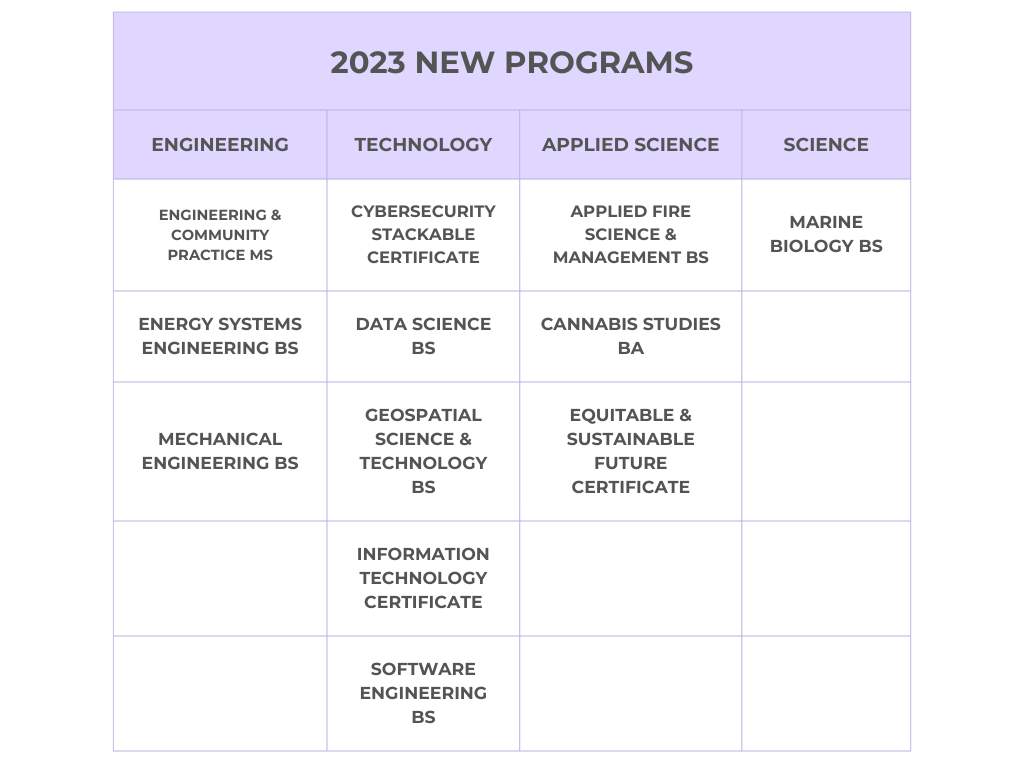
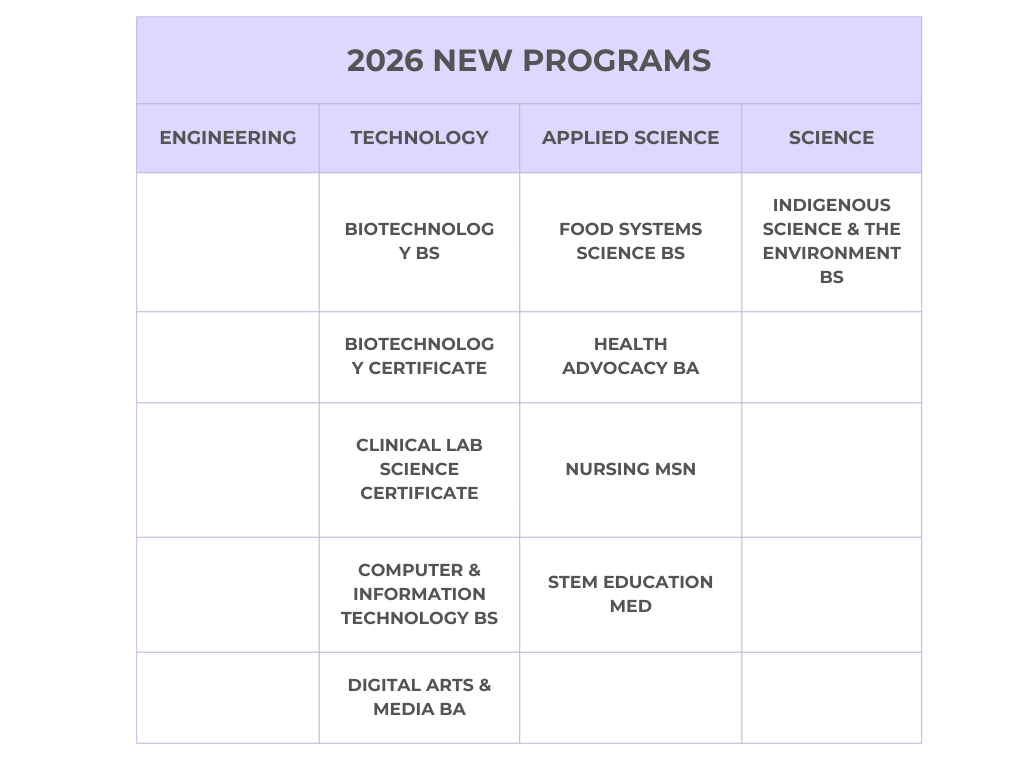
As Cal Poly Humboldt continues to expand, the university is actively adding new programs within various departments and hiring new faculty, being twelve new programs in fall of 2023 and spring 2024 and approximately 39 faculty. Engineering, technology, applied science, and science are the departments that have added new programs.

The College of Natural Resources and Sciences (CNRS) gained seven new programs for the 2023-2024 academic year, especially because engineering falls under that umbrella. According to Eric Riggs, Dean of CNRS, in many ways having all of these programs together is a huge advantage because they are able to cross-pollinate all of these disciplines.

Riggs expressed that the university is focusing on making sure that they implement the Cal State system while also “constantly acknowledging the needs of society, not just sort of doing science for its own sake and then applying it without consequence.”

An individualized degree program (IDP) has been added which allows students to either get a general bachelor’s degree from Cal Poly Humboldt or sit down with the IDP director, Rebecca Robertson, and create a degree that is unique to what a student wants.

“There are testimonials already from a number of students who are like, this prevented me from dropping out, or this made me come back to school,” Jenn Capps, Provost of CPH said when speaking about the IDP program.

According to Capps, the decision to develop all the new programs came from listening to students, faculty, and employers, reviewing workforce demand data, looking at which programs campuses have that are in high demand but are also competitive and thinking about what programs are best suited for students who are interested in going to graduate school.

Some of the new faculty were purposefully chosen to work in multiple colleges at the university. “There’s also been some intentionality in the new programs and in the faculty hires to look for connections between the colleges, because I think in our vision of what it means to be a polytechnic is we advance that kind of unified vision,” Riggs said.

While the College of Arts, Humanities, and Social Sciences (CAHS) did not receive as many new programs as CNRS, there have been a number of new hires within the college, and a few cross-disciplinary programs that involve CAHS.

“I would argue that journalism, the arts, for example, and then other fields also are polytechnic in nature in that there applies direct learning that is done with the learning experience, but then the work and the way it engages directly with the community,” Jeffery Crane, Dean of the College of Arts, Humanities, and Social Sciences said.

In 2022, 22 new faculty were brought on to aid in these new programs and others that aren’t polytechnic-related such as arts, humanities, ethnic studies, social sciences, and professional studies. For the academic year 2023-2024, another 17 faculty were hired.

To ensure the hiring of diverse faculty and staff, Cal Poly Humboldt has implemented a number of strategies. Go to http://www.humboldt.edu/about/polytechnic/staff-and-faculty-faqs for a complete list and additional details. For faculty hired for the academic year 2022-2023, over 50 percent of the faculty are BIPOC, according to Capps. Numbers are not yet available for 2023-2024.

Groups such as the BIPOC Faculty Affinity Group have been in place for many years, but recently, a BIPOC Staff Affinity Group has been developed, which according to Capps, had 60 to 80 people attend the first meeting who were seeking out support.

The most recent professional development day for faculty and staff focused on the university’s anti-racism action plan and highlighted combatting unconscious biases. “We had over 250 people come from campus,” Capps said.

Some of the things this extra support has done are ongoing program orientations and connecting faculty with people beyond their respective departments which develops inter-disciplinary collaboration. New hires are also given help with less institution-related topics such as where to find good healthcare providers or good places to eat to further orient them to the community.

“We were researching the acceptance numbers in the spring, and we were quite worried. So, I’m glad that the amount of students who have actually come is more appropriate to the amount of faculty to give them that really thorough experience. It’s a little bit more one-on-one, you know, classroom space, lab space, housing is an issue, I mean, all of it is wrapped together,” Riggs said.

Daniel O’Shea: the sustainable waterman

by Ruby Cayenne

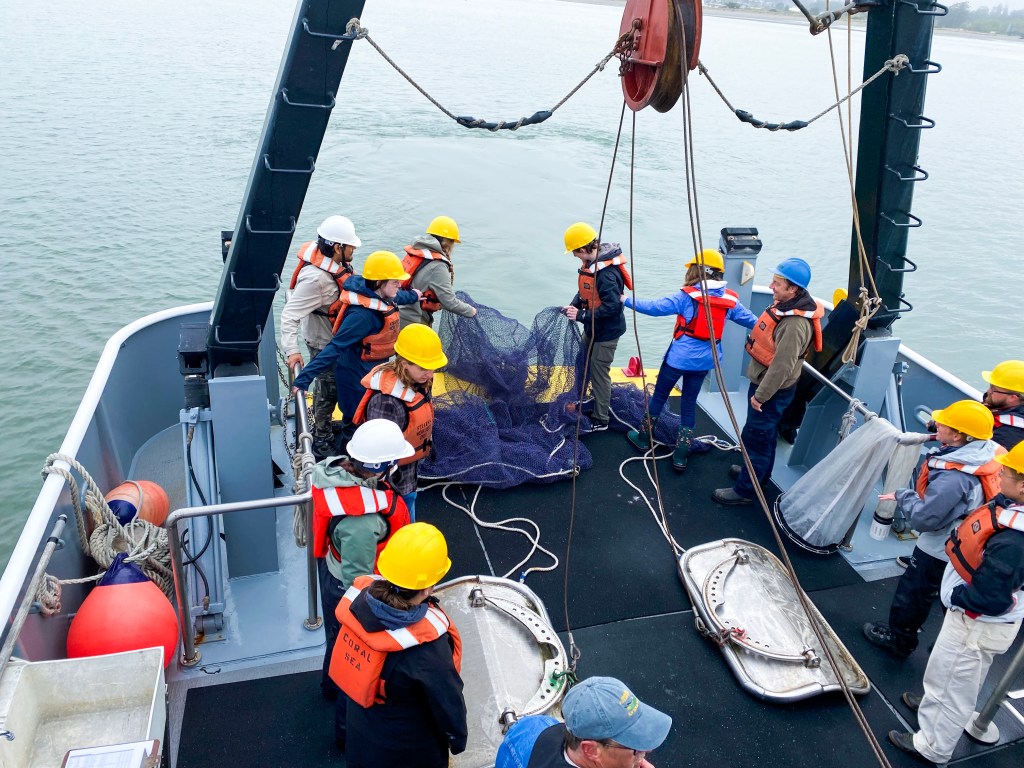
Daniel O’Shea in a blue work helmet assisting students in his Oceanography class on the Biological Ocean Cruise on the Coral Sea.

The ocean can touch you somewhere deep if you let it. It is one thing to love the ocean but another thing to let it beautifully consume you. On the coast of Northern California resides a man who deeply cares and worries for the world’s oceans. He spends his days by the ocean in moments of freedom and teaches all he can about the ocean in moments of learning, as a professor of oceanography at Cal Poly Humboldt. Daniel O’Shea has not only let the ocean be a part of his life, he has made the ocean his life.

O’Shea grew up in Redwood City. As a child in the 1960s, his mother made it a priority to be by the ocean. They would frequently go to Half Moon Bay, or Santa Cruz on special occasions. “We just had pieces of styrofoam and we’d ride the waves and goof off,” O’Shea said.

As a child, O’Shea began sailing at Half Moon Bay, first at camp and later with friends in high school and college. “Sailing is quiet, other than the water splashing on the sides of the boat. So, it’s very peaceful,” O’Shea said. O’Shea moved to Humboldt at age 17 to attend university and grew fond of the place’s easygoing and sustainability-based nature. 

O’Shea began surfing and it caused him to realize he was very curious about what existed and transpired in the waters beyond the shoreline. “My favorite spot to surf is Agate Beach up near Sue Meg Park. That was the first place I surfed. The night before I had a dream I stood up and caught a wave. I was out the next day and paddled into a wave, I was thinking about that dream and caught the wave,” O’Shea said.

This experience made O’Shea think deeply about manifestation and intentional actions. He wanted to expand his focus on the ocean and searched for an opportunity. “Then, my partner at the time brought home a piece of paper that said research assistant wanted,” O’Shea said. 

He was hired for the position and was able to pursue a graduate degree while working on oceanic research simultaneously. From the deck of a ship, he began mapping the ocean floor outside Humboldt Bay. O’Shea discovered that the bay was once much farther out to sea than it is now, further confirming existing models of sea level rise over the last 20,000 years. 

O’Shea eventually transitioned to teaching, and for a time, taught simultaneously at College of the Redwoods and Cal Poly Humboldt, formally Humboldt State University. “That was getting to be too much, so I stopped teaching at CR and I’ve just been at Humboldt. I have plenty of classes here and I love working with the students and going out to sea,” O’Shea said. 

“He is such an integral part of the department. He goes above and beyond to help us improve the program and make it a good place for our majors,” Christine Cass, Oceanography Department Chair said when describing O’Shea. 

A former student of O’Shea’s, Otilija Borisoviate, chose to pursue oceanography and expressed a deep appreciation for his teachings and how he carries himself in the classroom and life, especially in his ability to make science personable. “I definitely feel grateful to him. He’s been a guide and just an amazing person in my life as my friend and as a professor,” Borisviate said. 

“Every time I see him, I learn something new. It’s cool how much he knows about how the world works and how the ocean ecosystem functions,” O’Shea’s daughter Elena O’Shea said. Elena and her brother grew up living off the grid and spending much of their time exploring the beach where they’d look at different creatures, ask questions, and learn much from their father. 

To facilitate sustainable practices on an individual level, O’Shea advocates for reducing one’s energy consumption. By facilitating peace and sustainable practices in our homes and our communities, O’Shea feels that peace can be built up and ripple outward, ultimately affecting the world as a whole. 

“When I moved to Trinidad in 1986, the place I moved didn’t have electricity,” O’Shea said. He opted for solar energy instead of running a power line on his property and implemented a hydropower generator in the creek on his land. He continues to live sustainably and remains off the grid. This way of living has given him a unique perspective on having a heightened sense of awareness of how much electricity he consumes. 

Building a homestead and gardening are passions of O’Shea’s. “I have got a beautiful batch of garlic going right now. Last year I grew the three sisters, corn, beans, and squash,” O’Shea said. He uses an old cast iron tub in his garden as a fire tub, burning fallen branches underneath to heat the water and then pouring it into the garden after. His love of playing the guitar and singing has prevailed for many years. “I also like to hang out down by the creek and just sit and watch the water flow by.” His two cats often join him. 

The calamitous nature of humans is troubling to O’Shea. “Lots of wars are going on, and it’s very distressing to me, war is the most destructive thing I see we do on this planet as a species, but I also realized that there are a lot of people that are working toward positive, constructive outcomes,” O’Shea said. 

As O’Shea has grown his awareness and life experience, he has witnessed more constructive and positive forces in the world than harm or destruction. He feels there is both an immense amount of loss and an immense amount of healing happening on Earth. “So, I’ve come to my philosophy that things are getting better, faster than they’re getting worse,” O’Shea said. 

CUNA: restoring Carlson Park and beautifying Valley West 

by Ruby Cayenne 

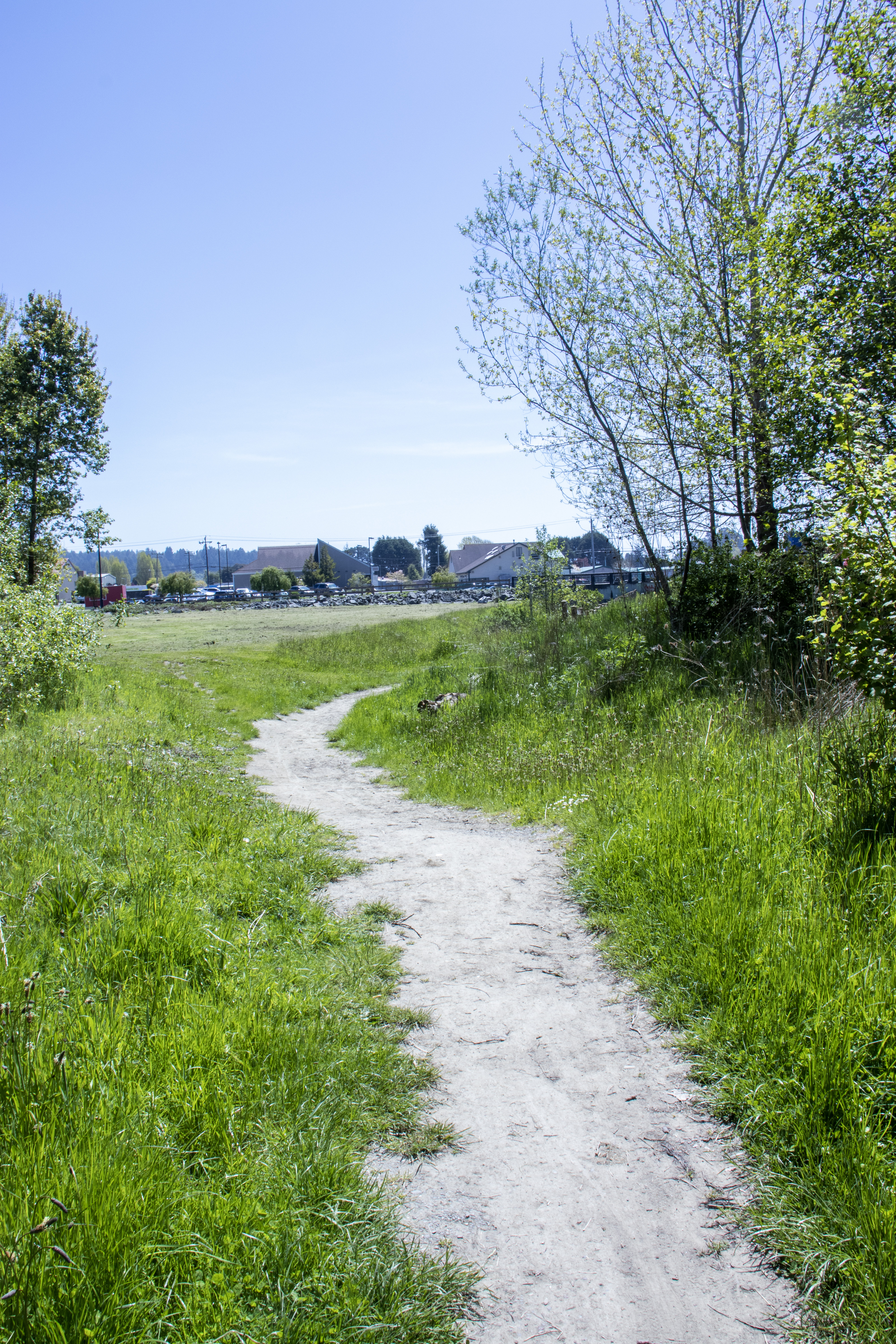
 Carlson Park in Valley West | Photo by Ruby Cayenne

On Thursday, April 6, State Senator Mike McGuire joined Arcata City Council members and Comunidad Unida Del Norte De Arcata (CUNA) co-coordinators to give $1 million for the development of Carlson Park in Valley West. In total, the park has been endowed with $2.5 million in funding for restoration. Other grants came from the Wildlife Conservation Board and Rural Recreation and Tourism. 

CUNA has been a vital motivator of this project, by adopting the park, holding clean-ups and continually advocating for it to the City of Arcata. CUNA is deeply involved with the beautification of the entire North Arcata area since its formation during the COVID-19 pandemic. 

The grants funding the Carlson Park restoration will be used to build a playground, a picnic area, and a special events area. Improving river access and trails will allow for boating and swimming in the Mad River. The park will also have public restrooms, pickleball, and multi-use courts. 

“Redwood Coast Energy Authority will be collaborating for EV charging stations at a planned parking lot,” said Emily Sinkhorn, Director of Environmental Services. 

CUNA is co-coordinated by three women who have been living or serving in the community of Valley West for decades. Kimberly White is an Arcata City Council member and graduate of Cal Poly Humboldt. Eibar Romero is currently studying Critical Race, Gender and Sexuality Studies at CPH. Laura Muñoz is a “bilingual dance and theater maker, educator, somatics practitioner, and community organizer,” according to the CUNA website. 

“They’re [the City of Arcata] going to be doing bilingual signage on the trails in Spanish, English, and Wiyot language, invasive species removal, and planting native species. There’s going to be an Americans with Disabilities Act (ADA) compliant lookout. So, those who cannot make it down the trails are going to get this incredible view of our wonderful Mad River right there,” White said. 

I’m excited about the opportunities to really build community and hopefully also bridge the different demographics,” Muñoz said. “It’s not a moment too soon that Carlson Park is going to be available for families, for kids, for recreation, and really to work for a better way of living like kids playing outside and being outdoors.” 

In the Valley West community, CUNA has incorporated the participatory budgeting process into its work by speaking with a wide range of demographics in the community including the elderly, Latinx and unhoused. These conversations brought attention to the fact that there was less of a desire for grand gestures and more for securing essential services. “They were not thinking big. They were just like we need police out here. We need a garbage can. You know, just the basics,” White said. 

Not only did CUNA provide those basics to Valley West, but they were also able to secure barbecue facilities that are ADA compliant, plant fruit trees, have dance classes and have children’s theater. They have organized and facilitated tianguis, a Latinx style open-air market and block parties for disaster preparedness and community building. This showcased local mariachi bands and artists and intent on developing a community garden, reported CUNA co-coordinators. 

“Valley West hasn’t received a lot of attention years back, so it’s super awesome and I think it makes the Latinx community feel heard or seen that there is going to be attention to that community where they live,” Romero said.