Enfermedad mata a gran número de focas y leones marinos en Humboldt

por Ruby Cayenne traducido por Esmeralda Macias

Los pasantes de MMERP miden y examinan mamíferos marinos variados en la playa Trinidad State y verifican la condición y especie. Todas las investigaciones de mamíferos marinos son hechas bajo el permiso NMFS MMHSRP #18786.03 | Foto por Ben Pridonoff

El condado de Humboldt y otras partes de California han visto un incremento de varamiento y muerte en mamíferos marinos causado por la enfermedad bacteriana llamada Leptospirosis.

Afecta a los riñones de focas y leones marinos y puede causar parálisis y muerte. Humanos y mascotas pueden contraer esta enfermedad a través de contacto con los fluidos corporales de mamíferos marinos como la orina o desecho en agua, tierra, y arena, remarcó la Directora de Relaciones del Cal Poly Humboldt Telonicher Marine Lab, Emily Curry. Ella también recomendó no comer mariscos o pesca- do que fue pescado localmente porque pueden tener Leptospirosis.

Leptospirosis puede causar fiebre alta, dolor de cabeza, escalofríos, dolor muscular, vómito, ictericia, ojos rojos, dolor abdominal, diarrea, y sarpullido en la primera fase. Si la segunda fase pasa sin tratamiento, una persona puede tener un fallo de riñones o hígado o meningitis, según Centros para el Cotrol y Prevención de Enfermedades.

Dawn Goley es la directora del Cal Poly Humboldt’s Marine Mammal Stranding Program (MMSP) y Marine Mammal Education and Research Program (MIRP). Goley, empleados y estudiantes trabajan juntos en monito rear a mamíferos marinos muertos arrastrados por la marea en los condados de Humboldt, Del Norte y Mendocino.

El número normal de muertes de mamíferos marinos por Leptospirosis es de 120 en un año, explicó Goley. Desde septiembre del 2023, ya han sido 197 varamientos causados por esta enferme- dad.

“Hay un gran incremento en el número de mamíferos marinos que están varados y la mayoría de esos son leones marinos Californianos,” Goley dijo.

Goley dijo que muchos leones mari- nos contrajeron una neurotoxina durante el verano causando un gran brote de alga por las cálidas temperaturas del sur de California. Los que sobrevivieron y migraron hacia el norte por el invierno están probablemente débiles haciéndolos más susceptibles a Leptospirosis.

“…Cuando empezaron a llegar, notamos un aumento en las variaciones de estos animales en particular,” Goley dijo. “Y se hizo obvio que estaban afectados por una enfermedad bacteriana llamada Leptospirosis.”

Miembros de la comunidad pueden reportar sobre mamíferos marinos muertos en playas locales contactando a Cal Poly Humboldt Marine Mammal Stranding Program a marinemammals@humboldt.edu o a su linea directa al 707-826-3650. Si el mamífero marino está enfermo o herido, por favor llamen a la línea directa de North Coast Marine Mammal Center al 707-951-4722.

“Si los que están reportando pueden dar una buena descripción de la ubicación (líneas de latitud/longitud ayudan muchos pero no son necesarias), y también foto(s) del animal– eso seria los más útil para que podamos reaccionar más rápido,” Goley dijo.

Unos cadáveres pueden tener bridas en sus aletas, lo que significa que el animal ya ha sido examinado y reportado a una red de varamientos.

El Cal Poly Humboldt Marine Mammal Stranding Program está disponible para estudiantes de cualquier carrera y no tiene requisitos. Para estar en la lista de correo electrónico para una aplicación, manden mensaje a marinemammals@humboldt.edu.
Disease killing high number of seals and sea lions in Humboldt County

by Ruby Cayenne

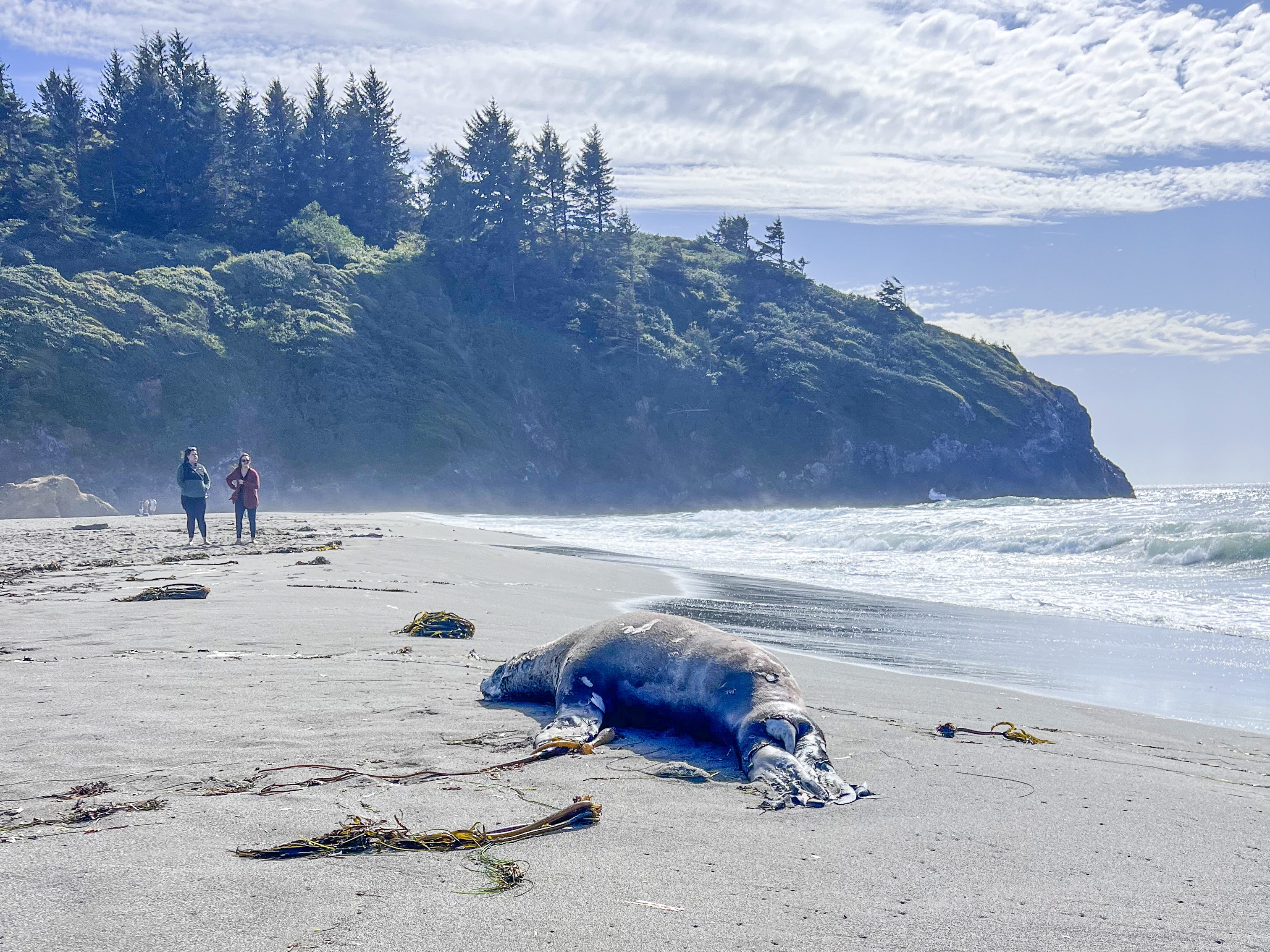
The MMERP interns measure and examine stranded marine mammal at Trinidad State Beach and verify the condition and species. All marine mammal research is carried out under NMFS MMHSRP permit # 18786.03| Photo by Ben Pridonoff

Humboldt County and other parts of California have seen a spike in marine mammal strandings and deaths caused by a bacterial disease called Leptospirosis.

It affects the kidneys of seals and sea lions and can lead to paralysis and death. Humans and pets can contract this disease through contact with bodily fluids from marine mammals such as urine or feces in water, soil and sand, remarked Outreach Director for the Cal Poly Humboldt Telonicher Marine Lab, Emily Curry. She also recommends not consuming shellfish or fish caught locally because they may have Leptospirosis.

Leptospirosis can cause high fever, headache, chills, muscle aches, vomiting, jaundice, red eyes, abdominal pains, diarrhea, and rashes in the first stage. If the second phase occurs untreated, a person may have kidney or liver failure or meningitis, according to the Centers for Disease Control and Prevention.

Dawn Goley is the director of Cal Poly Humboldt’s Marine Mammal Stranding Program (MMSP) and Marine Mammal Education and Research Program (MIRP). Goley, staff and students work together to monitor dead marine mammals that wash up on shore in the counties of Humboldt, Del Norte and Mendocino.

The normal number of marine mammal deaths due to Leptospirosis is around 120 in a year, explained Goley. As of Sept. of 2023, there had already been 197 strandings caused by this disease. 

“There’s a huge uptick in the number of marine mammals that are stranding and the majority of those are California sea lions,” Goley said. 

Goley said many sea lions contracted a neurotoxin in the summer caused by large algae blooms from rising sea temperatures in southern California. The ones that survived and migrated Northward for the winter are likely weakened making them more susceptible to Leptospirosis.

“…when they started to come up here, we started to have an increase in strandings of those animals in particular,” Goley said. “And it became apparent that they were affected by a bacterial disease called Leptospirosis.”

Community members can reach out to report a dead marine mammal on local beaches by contacting the Cal Poly Humboldt Marine Mammal Stranding Program at marinemammals@humboldt.edu or our hotline at 707-826-3650. If the marine mammal is sick or injured, please call the North Coast Marine Mammal Center hotline at 707-951-4722.

“If the reporters can share a good description of the location (latitude/longitude are especially helpful, but not necessary), as well as a photo(s) of the animal – that would be the most helpful for us to mount a quick response,” Goley said.

Some carcasses may have zip ties around their flippers which means that the animal has already been examined and reported to the stranding network.

The Cal Poly Humboldt Marine Mammal Stranding Program is available to students of any major and has no prerequisites. To get put on the email list for an application, message marinemammals@humboldt.edu.

Decolonizing Sustainability Speaker Series continues on Oct.12 at Cal Poly Humboldt with professor Kaitlin Reed

by Ruby Cayenne

Left: Speaker Brittani Orona who presented on Sept. 14 | Photo provided by Orona. Right: Speaker Kaitlin Reed who is presenting Oct. 12 | Photo provided by MARCOM

Two additional speakers will take part in the Decolonizing Sustainability Speaker Series this fall. The first speaker was Brittani Orona on Sept.14, and the next speakers are professors Kaitlin Reed on Oct. 12 and Dana Loyd on Nov. 16. The in person events will be at the Native American Forum room BSS 162 at Cal Poly Humboldt from 5 – 6:30 p.m.

“The speaker series is really designed to kind of interrogate the centrality of settler colonialism and white supremacy in a lot of American environmental movements, both historically and in the present,” said Assistant NAS Professor and Traditional Ecological Knowledge (TEK) Faculty Fellow Kaitlin Reed. She is the main organizer of the series and an enrolled member of the Yurok Tribe.

Brittani Orona – September Highlights 

Orona is University of California president’s postdoctoral fellow at UC Santa Cruz and serves as the Board Secretary for Save California Salmon, among many other things. She is an enrolled member of the Hoopa Valley Tribe. Her research and teachings are focused on Indigenous history and human rights, environmental studies, public humanities and visual sovereignty.

Orona explained that the subject of her talk on dam speculation focuses on her current research around the organized resistance against the proposed water infrastructures on the Klamath River from colonization into the present day.

“The period of dam speculation began with early colonization on the Klamath River Basin when various waves of settlers from both the Upper Basin and the Lower waged violent wars against Native people,” Orona said. “These wars began the period of resource extraction and environmental degradation through salmon fisheries, timber and gold mining.”

Orona argued that many Californian agencies say they didn’t formerly understand how building dams on the river would affect Native people and the environment. She argues that they fully understood how they would affect these things and that this argument of past ignorance is “an interesting settler scheme.”

“So, the occupation of stolen lives, lands, stolen lives, dispossession, all of this that I’m talking about right now, very much ties into climate catastrophe,” Orona said. “And it starts during this very intense period of colonization. And I’m really looking here at the Klamath River Basin as an example of this.”

Kaitlin Reed – Oct. 12

Reed explained that conservation and preservation movements are often juxtaposed with mindsets that want to take from nature when in fact, they are “two sides of the same coin, a very Eurocentric coin.” Reed explained that these mindsets view humans as being separate from nature rather than just a part of the same system as humans.

Professor Reed just published a book called Settler Cannabis: From Gold Rush to Green Rush in Indigenous Northern California, which is the topic of her talk.

The green rush refers to cannabis cultivation, specifically trespass cultivation. The book also touches on the timber rush and the fish rush, and concludes with a critique of the back to the land movement, Reed said. She explained that in Humboldt, the back to land movement is often romanticized, when in fact, its origins stem from white people leaving urban and suburban areas to buy up land in Humboldt that became very cheap because of the timber collapse.

“They quickly realized they had no idea how to live off the land,” Reed said when speaking about the need for money that was soon realized by the settlers. “So, they start cultivating cannabis as a way to earn a cash income.”

Reed goes deep in her book about cannabis cultivation in Yurok Ancestral Territory as well as other tribal nations and the exclusion of tribal nations’ participation

in the legal cannabis economy. She stated that trespass cultivation affects water and land by toxifying them and is also a source of land dispossession and violence toward Indigenous people.

She argues that before we can envision a sustainable cannabis industry, land needs to be given back and the dams must come down so that the rivers can recover from the critical condition they are currently in.

New academic programs and faculty at Cal Poly Humboldt

by Ruby Cayenne

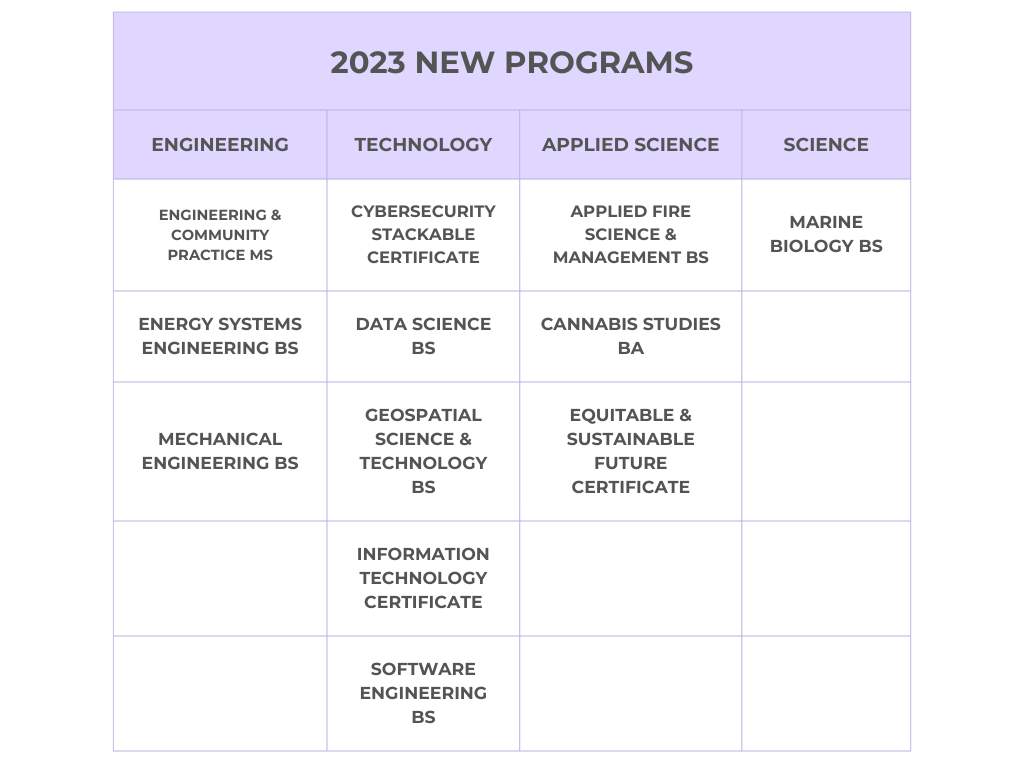
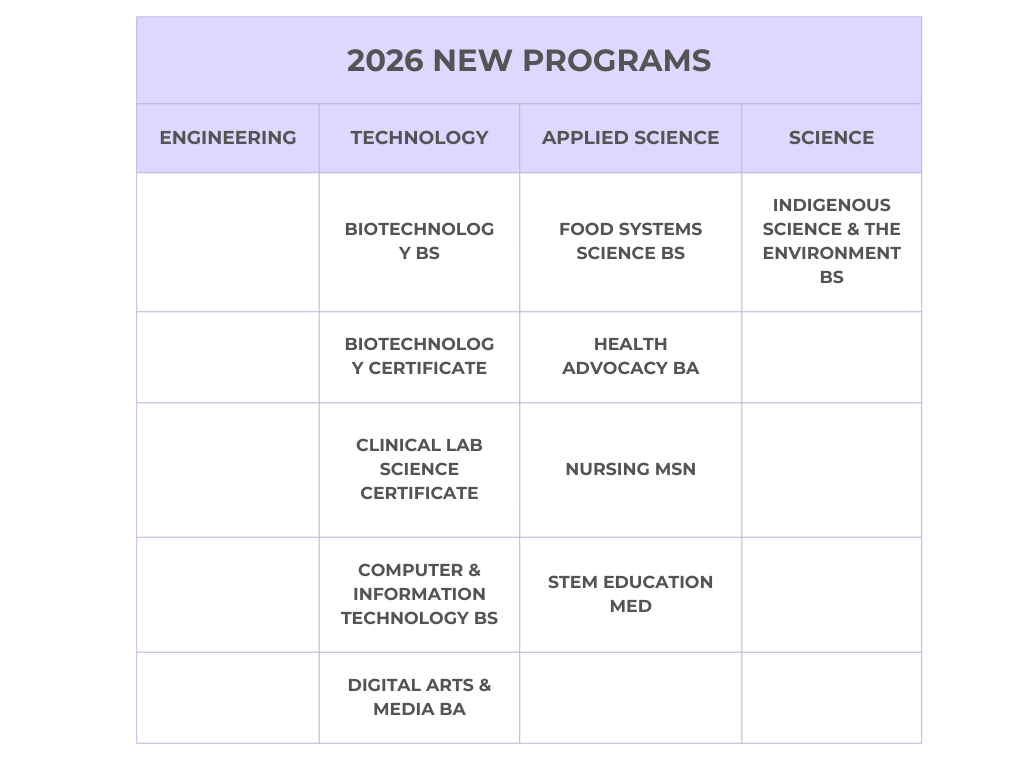
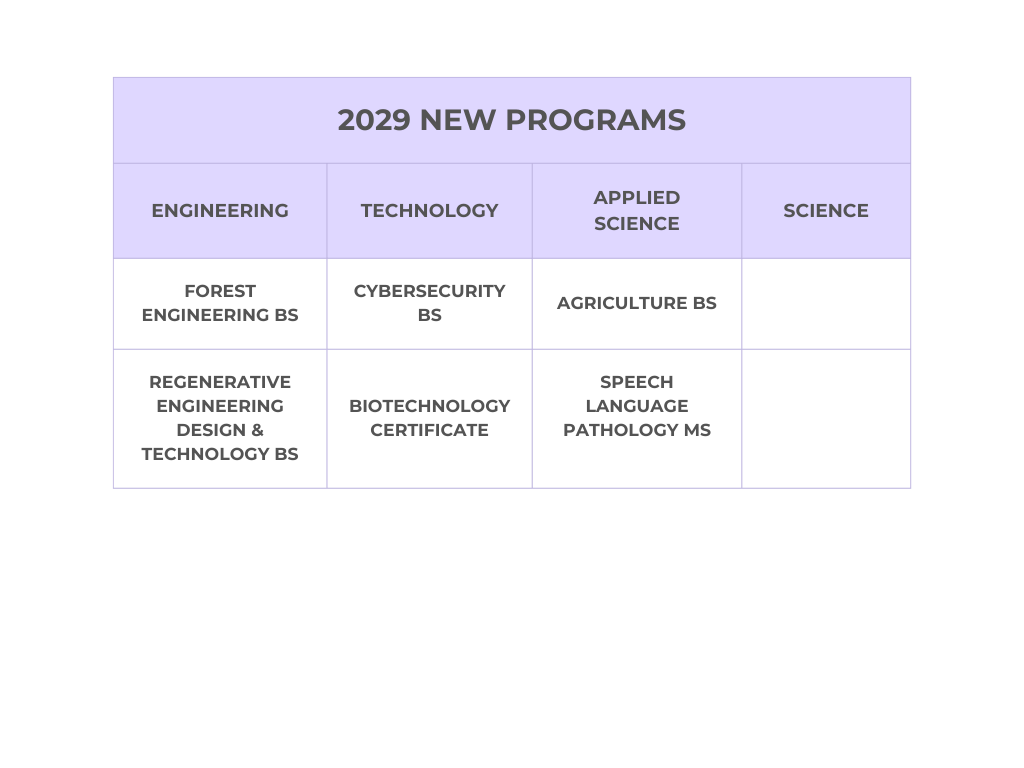
As Cal Poly Humboldt continues to expand, the university is actively adding new programs within various departments and hiring new faculty, being twelve new programs in fall of 2023 and spring 2024 and approximately 39 faculty. Engineering, technology, applied science, and science are the departments that have added new programs.

The College of Natural Resources and Sciences (CNRS) gained seven new programs for the 2023-2024 academic year, especially because engineering falls under that umbrella. According to Eric Riggs, Dean of CNRS, in many ways having all of these programs together is a huge advantage because they are able to cross-pollinate all of these disciplines.

Riggs expressed that the university is focusing on making sure that they implement the Cal State system while also “constantly acknowledging the needs of society, not just sort of doing science for its own sake and then applying it without consequence.”

An individualized degree program (IDP) has been added which allows students to either get a general bachelor’s degree from Cal Poly Humboldt or sit down with the IDP director, Rebecca Robertson, and create a degree that is unique to what a student wants.

“There are testimonials already from a number of students who are like, this prevented me from dropping out, or this made me come back to school,” Jenn Capps, Provost of CPH said when speaking about the IDP program.

According to Capps, the decision to develop all the new programs came from listening to students, faculty, and employers, reviewing workforce demand data, looking at which programs campuses have that are in high demand but are also competitive and thinking about what programs are best suited for students who are interested in going to graduate school.

Some of the new faculty were purposefully chosen to work in multiple colleges at the university. “There’s also been some intentionality in the new programs and in the faculty hires to look for connections between the colleges, because I think in our vision of what it means to be a polytechnic is we advance that kind of unified vision,” Riggs said.

While the College of Arts, Humanities, and Social Sciences (CAHS) did not receive as many new programs as CNRS, there have been a number of new hires within the college, and a few cross-disciplinary programs that involve CAHS.

“I would argue that journalism, the arts, for example, and then other fields also are polytechnic in nature in that there applies direct learning that is done with the learning experience, but then the work and the way it engages directly with the community,” Jeffery Crane, Dean of the College of Arts, Humanities, and Social Sciences said.

In 2022, 22 new faculty were brought on to aid in these new programs and others that aren’t polytechnic-related such as arts, humanities, ethnic studies, social sciences, and professional studies. For the academic year 2023-2024, another 17 faculty were hired.

To ensure the hiring of diverse faculty and staff, Cal Poly Humboldt has implemented a number of strategies. Go to http://www.humboldt.edu/about/polytechnic/staff-and-faculty-faqs for a complete list and additional details. For faculty hired for the academic year 2022-2023, over 50 percent of the faculty are BIPOC, according to Capps. Numbers are not yet available for 2023-2024.

Groups such as the BIPOC Faculty Affinity Group have been in place for many years, but recently, a BIPOC Staff Affinity Group has been developed, which according to Capps, had 60 to 80 people attend the first meeting who were seeking out support.

The most recent professional development day for faculty and staff focused on the university’s anti-racism action plan and highlighted combatting unconscious biases. “We had over 250 people come from campus,” Capps said.

Some of the things this extra support has done are ongoing program orientations and connecting faculty with people beyond their respective departments which develops inter-disciplinary collaboration. New hires are also given help with less institution-related topics such as where to find good healthcare providers or good places to eat to further orient them to the community.

“We were researching the acceptance numbers in the spring, and we were quite worried. So, I’m glad that the amount of students who have actually come is more appropriate to the amount of faculty to give them that really thorough experience. It’s a little bit more one-on-one, you know, classroom space, lab space, housing is an issue, I mean, all of it is wrapped together,” Riggs said.